
Il paese volante
Il paese volante
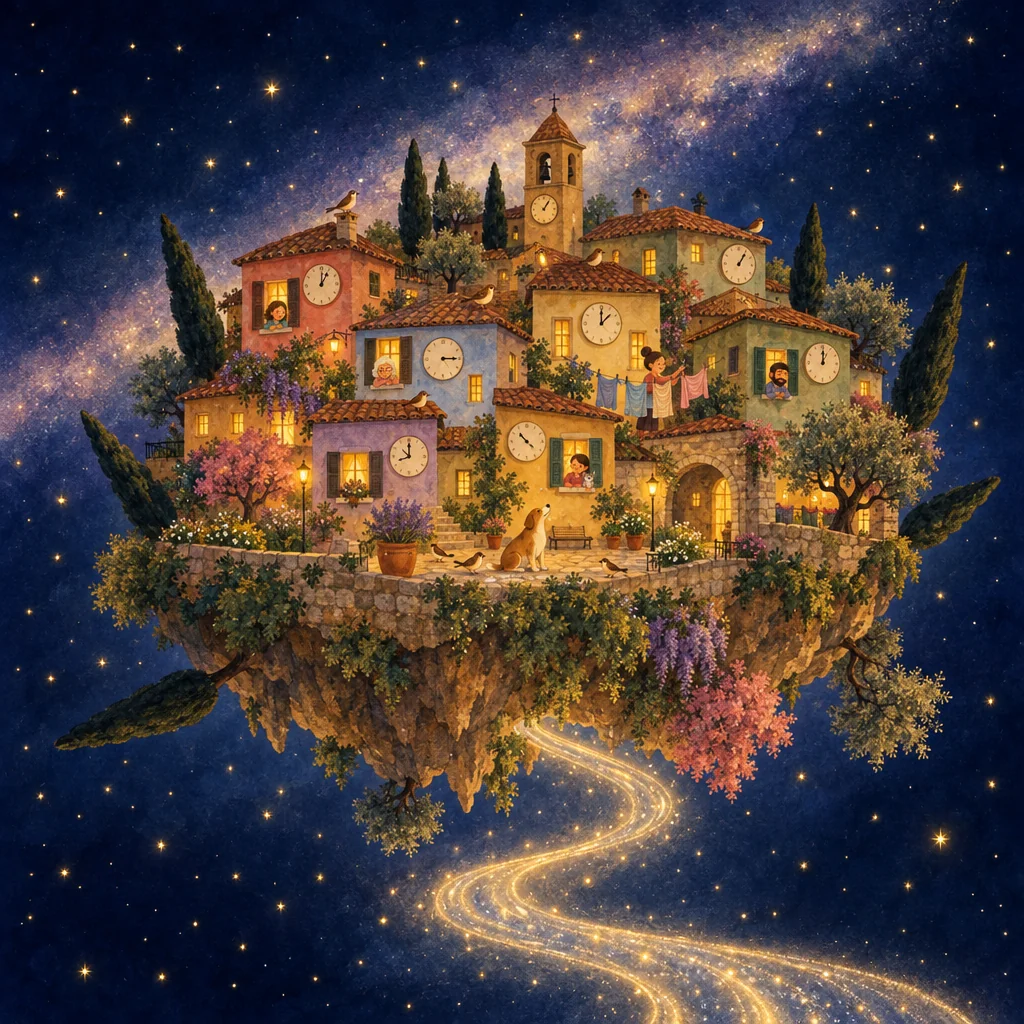
Nella vastità dell’universo c’era un paese di nome Ficulle. Sembrava normale, ma era volante.
Girando di continuo insieme alla Terra nella Via Lattea, il fine settimana faceva sempre una pausa di una mezz’ora e tutti gli abitanti si mettevano a sedere tranquilli, approfittandone per rilassarsi, sorseggiando un bel cappuccino schiumante. E poi via, si riparte!
Dopo la sosta al bar spaziale, il paese continuava il suo giro e gli abitanti riprendevano a volare. E — anche se a voi vi sembrerà un po’ strano — gli uccellini a camminare; tanto è vero che, per bere ai fontanelli, dovevano fare due o tre salterelli.
Questo paese era proprio incantevole e magico. I fiori nei giardini si illuminavano con la luce della luna (anche di giorno!); il fiume era formato da scie di stelle cadenti; gli alberi cambiavano il colore delle foglie a seconda del vento… e dell’umore.
A pensarci bene, la vita su un paese volante è proprio interessante.
Tutte le case erano coloratissime, ma la vernice cambiava e le case mutavano colore di continuo, proprio come le foglie. Ognuna aveva un orologio sulla facciata, ma suonavano le ore in tempi diversi perché le lancette volavano a destra e a sinistra.
Gli abitanti, per mangiare, incollavano piatti, bicchieri e posate al tavolino; e se gli cadeva un pezzetto di pane, qualcuno sotto lo raccoglieva al volo. I cani avevano sempre il naso all’insù per approfittare dell’occasione per uno spuntino volante, ovviamente.
I nonni si alzavano in cielo con le loro scope di saggina e andavano per commissioni, ma per evitare incidenti e cantonate gridavano continuamente: «Largo, largo, siamo un po’ cecati!» I bambini sulle loro biciclette volanti ridevano a perdifiato. Mentre farfalle, api e anche calabroni brontolavano ed erano tutto un lamento, perché in aria c’era troppo movimento; tanto è vero che chiesero urgentemente dei percorsi preferenziali.
D’altronde, l’unico semaforo del paese aveva una sola luce, azzurra, e dava il via per il firmamento. C’era davvero un po’ troppo movimento e di tanto in tanto i vigili entravano in azione con le loro moto spaziali. Chi non rispettava le regole veniva costretto a camminare giù per terra!
Solo dopo il tramonto, gli abitanti smettevano di volare e dormivano di un sonno profondo fino all’alba. Le lucciole con le loro alette di notte fluttuavano in pace insieme ai pipistrelli con le loro ali a mantello.
Un giorno, di mattina presto, quando all’alba il paese aveva ripreso il suo girovagare, un circo intergalattico si posò in un grande prato vicino alla biblioteca. Che sorpresa, che magia! Clown, saltimbanchi, trapezisti e giocolieri misero il naso fuori e, uscendo dal tendone, si misero a camminare con i piedi in su e la testa in giù. Il sindaco del paese ebbe un’idea e pensò: «Forse loro possono accomodare le lancette degli orologi che svolazzano a destra e sinistra senza regola.» Così fu.
Il capo trapezista aveva osservato che l’unico orologio che andava a modo era quello che segnava le ore sulla torre dell’osservatorio astrale. Allora, senza esitazione, prese una fune ed il trapezio e, oscillando in qua e in là, proprio come un pendolo, riuscì a connettere con dei fili magici tutte le lancette degli orologi pazzerelli a quelle della torre. Da quel momento, le ore suonarono in coro.
Che gioia incredibile! Gli artisti del circo furono i benvenuti nel paese volante e, come in una favola, alle 19 e 36 in punto iniziarono le esibizioni. Gli spettacoli del circo attiravano tutto il paese e, come gli spettatori entravano sotto il tendone, per magia e con stupore smettevano di volare. I popcorn stavano tranquilli nei loro sacchetti, per farsi sgranocchiare.
Gli artisti si esibivano al meglio. I clown consegnavano ad ogni bambina e bambino un palloncino colorato, da far volare in cielo al momento dell’uscita. I bambini erano felici e tutti i circensi invece pure.
Perfino l’Orsa Maggiore e la sua nipotina, l’Orsa Minore, sentendo applausi e risate venire dal grande tendone colorato, decisero di interrompere per un’oretta il loro perpetuo girovagare per la Via Lattea. Si presero un bel cappuccino schiumante e videro cosa stava succedendo.
Avevano già sentito dire di questo paese volante dove tutto andava in qua e in là e dove c’era una gran confusione. Ma, avvicinandosi al circo, videro uno striscione di benvenuto con scritto: «Qui si fa spettacolo, si vola, si gioca, ci si diverte e non si paga niente.» L’Orsa Maggiore non perse tempo e, rivolgendosi alla nipotina, disse: «Ma che chiacchiere mette in giro l’universo? Questo sembra proprio un bel posto tranquillo, da viverci e da visitare! C’è pure un bel circo itinerante… forse anche quello è volante!»
The Flying Town
In the vastness of the universe, there was a town called Ficulle. It looked normal enough, but it was flying.
Forever turning along with Earth through the Milky Way, every weekend it took a half-hour pause, and all the residents would sit down peacefully — making the most of it to relax over a lovely frothy cappuccino. And then off they went again!
After the stop at the space bar, the town carried on its turning, the residents resumed flying, and — though it might seem a touch odd to you — the little birds went back to walking; so much so that to drink from the little fountains they had to hop along two or three times.
This town was truly enchanting and magical. The flowers in the gardens lit up with moonlight (even by day!); the river was a stream of shooting-star trails; the trees changed the colour of their leaves according to the wind… and the mood.
Come to think of it, life in a flying town is really rather interesting.
All the houses were brightly coloured, but the paint kept changing, and the houses shifted colour continuously, just like the leaves. Each had a clock on its façade, but they chimed the hours at different times because the hands flew left and right.
To eat, the residents glued plates, glasses and cutlery to the little table; and if a small piece of bread happened to fall, someone below would catch it in mid-flight. The dogs always kept their noses turned up, ready to seize the chance for a flying snack — obviously.
The grandparents took to the sky on their old-fashioned brooms and went off on errands, but to avoid bumps and collisions they shouted out continuously: “Mind out, mind out, we can’t see too well!” The children on their flying bicycles laughed their heads off, while butterflies, bees and even hornets grumbled and were one big complaint, because there was too much movement in the air — so much so that they urgently asked for priority lanes of their own.
Besides, the town’s only traffic light had a single light, sky-blue, that gave the go-ahead to the firmament. There really was a bit too much movement up above, and now and then the sky-constables would step in on their rocket motorbikes. Anyone who broke the rules was sentenced to walk down on the ground!
Only after sunset did the residents stop flying and fall into a deep sleep until dawn. The fireflies, with their little night wings, fluttered peacefully alongside the bats, with their cloak-like wings.
One day, early in the morning, just as at dawn the town had resumed its wandering, an intergalactic circus alighted in a large meadow near the library. What a surprise, what magic! Clowns, tumblers, trapeze artists and jugglers poked their noses out. As they emerged from the big top, they set off walking with their feet up and their heads down. The mayor of the town had an idea, and thought: “Perhaps they can mend the clock hands that flit left and right without any rule.” And so it was.
The head trapeze artist had noticed that the only clock running to rule was the one marking the hours on the tower of the astral observatory. So without hesitation he took up a rope and his trapeze and, swinging to and fro just like a pendulum, managed with magical threads to connect all the hands of the harum-scarum clocks to those of the tower. From that moment on, the hours chimed in chorus.
What incredible joy! The circus artists were welcomed in the flying town, and as if in a fairy tale, at 7:36 on the dot the performances began. The circus shows drew the whole town in, and as the spectators stepped beneath the big top, by magic and to everyone’s amazement they stopped flying. Even the popcorn stayed quietly in its bags, waiting to be munched.
The performers gave it their all, and the clowns handed out a colourful balloon to every girl and boy, ready to be set free into the sky on the way out. The children were happy — and so, just as much, were the circus folk.
Even the Great Bear and her little niece, the Little Bear, hearing applause and laughter come from the great colourful tent, decided to interrupt their perpetual wandering through the Milky Way — just for a little hour. They got themselves a lovely frothy cappuccino and saw what was going on.
They had heard tell of this flying town where everything went this way and that and there was a great confusion. But as they drew near the circus, they saw a welcome banner that read: “Here we put on shows, we fly, we play, we have fun — and pay nothing at all.” The Great Bear wasted no time and, turning to her little niece, said: “What chatter the universe puts about! This seems a lovely peaceful place, to live in and to visit. There’s even a fine travelling circus… perhaps that one’s flying too!”
Trova le Storie Sotto Le Stelle sul tuo lettore preferito. Find Storie Sotto Le Stelle on your favourite player.